

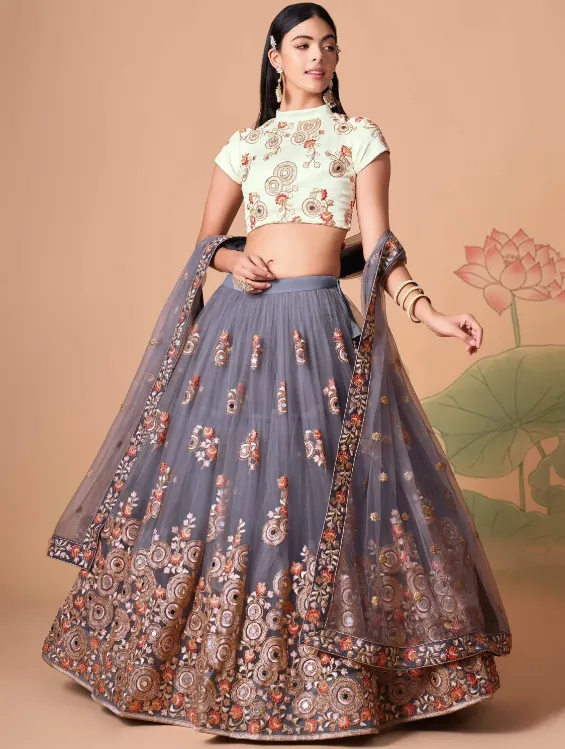
The flash is the first thing you notice about lehenga choli mirror work. The surprise comes when you tilt the cloth, and the flash disappears. What looked like a scatter of silver dots might turn out to be the centres of embroidered daisies, or a row of circles along a sleeve. Those details are worth looking at when you choose a festive outfit. They’re the reason two skirts in the same shade of green can look entirely different across a room.
What the Thread Contributes
Shisha is a form of embroidery that holds small pieces of mirror against cloth with thread. Kutch, a district of Gujarat, is especially known for it, and examples appear elsewhere in northwestern India. The thread does two jobs. It secures the reflective piece and gives it a shape within the design. A ring of orange around a mirror can read as a flower from a distance. Change that ring to green and the same piece can almost disappear among embroidered leaves.
How the Mirror Stays Put
A flat piece of mirror glass can be sewn onto cloth without piercing it. In one shisha technique, the embroiderer lays a grid of thread across its face, then works stitches around that foundation to make a rim. Buttonhole and chain stitches can form the decorative ring. Sometimes part of the grid remains visible across the glass. Look for those crossing threads when you examine a motif. What seems like a stray line in a photograph may be helping to hold the mirror in place.
A Flower With Eight Petals
On a black linen skirt made in India in the 1960s, each embroidered flower has eight petals and a little round mirror at its centre. Other mirrors sit between the flowers, and diagonal lines of gold chain stitch connect the motifs. The skirt rewards a closer look at the spaces between reflections. Cover one of the mirrors in a photograph with your fingertip and follow the gold line beside it. You can still trace the pattern all the way from flower to flower.
Different Finishes on One Outfit
Placement matters just as much on a Green Lehenga Choli made for Navratri. One bottle green set has a rayon skirt trimmed with gota patti lace, while its half-sleeved blouse carries real mirrors among multicoloured Gamthi embroidery. As the wearer turns, the lace catches light along the skirt, and individual mirrors flash near the face. With the dupatta draped to one side, the blouse embroidery stays visible when you sit down for dinner, long after the skirt has settled into its folds.
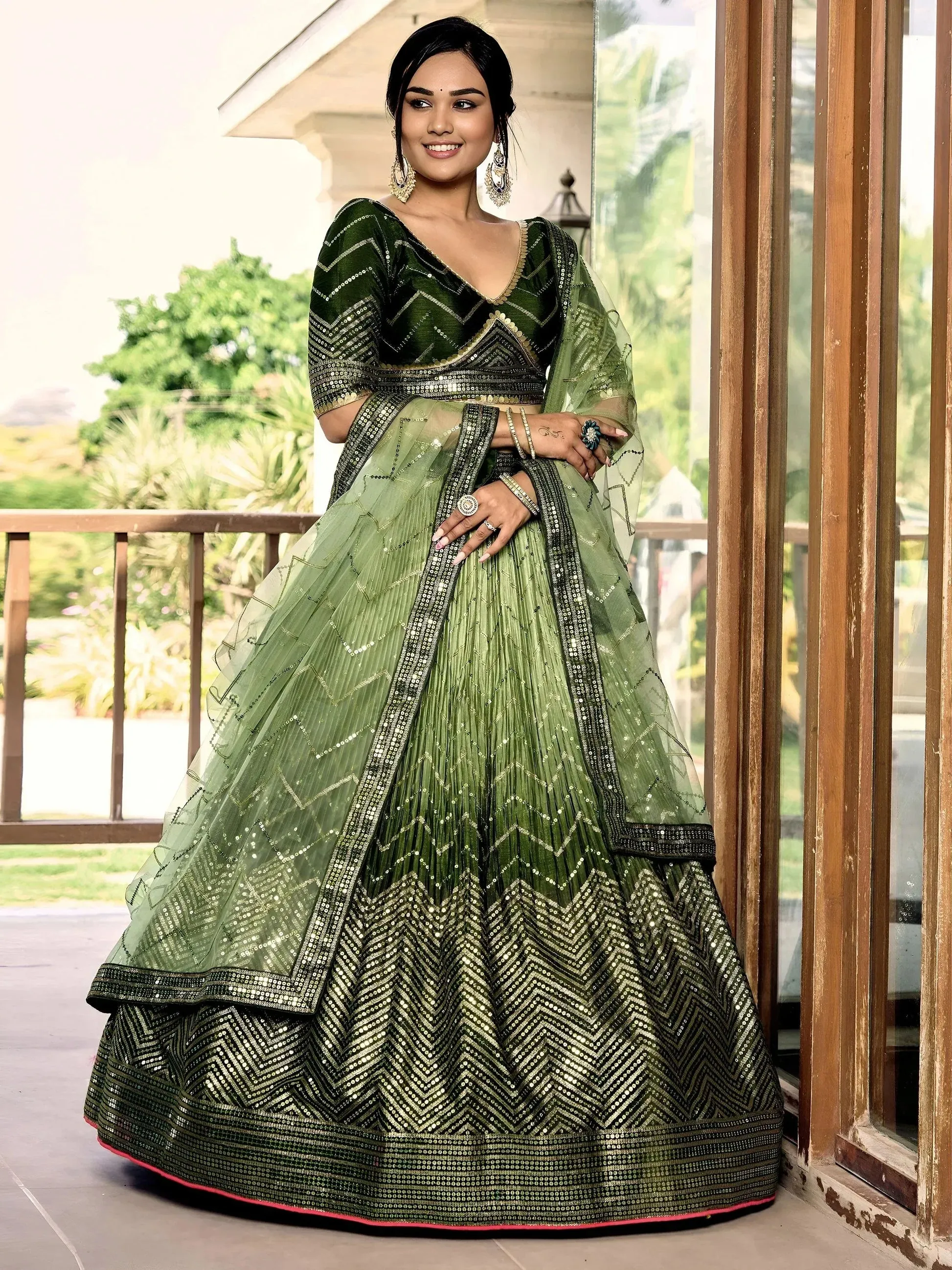
The Placement Behind the Label
A photograph cropped tightly around an embroidered sleeve can make a whole set look densely worked. The skirt may actually leave most of its fabric plain. If you’re choosing between two designs, ask to see the garment spread flat as well as a close view of the stitching. Together, those views show how the maker has framed each mirror and how much space lies between repeats. Look for these five arrangements to see where the sparkle will fall when you wear the outfit.
-
Mirrored flower centres
-
Bands around necklines
-
Rows along cuffs
-
Scattered skirt motifs
-
Mirror-edged dupattas
What Real Mirrors Tell You
Another Navratri set pairs a pure cotton green skirt with a blouse picked out in white and a white dupatta. Its description specifies real mirrors. That detail tells you what makes the outfit shine. To learn how the mirrors were attached, ask the seller about the embroidery process, particularly if you want a piece worked by hand. If the seller knows the maker, you might also learn the name of the person or workshop responsible for the embroidery you admire.
Where Embroidery Meets the Skin
Before wearing the outfit for a long evening, check how the raised embroidery feels at the points where your arm rests against the blouse. A smooth lining can make a decorated sleeve comfortable, while a loose loop at the cuff may catch on your bangles. Put on the bracelets you intend to wear and clap a few times. If one motif catches repeatedly, show it to the seller or tailor while you can point out exactly which edge needs attention.
Conclusion
When you have narrowed the choice to two designs, look at each one away from the brightest light. Pick out a detail you would enjoy even without the sparkle. It might be the orange petals around a mirror or the little line of stitches that leads into the next motif. Then turn the cloth towards a window and watch the reflection return. The outfit to take home is the one whose threadwork you already liked before the mirror began to shine.
